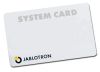


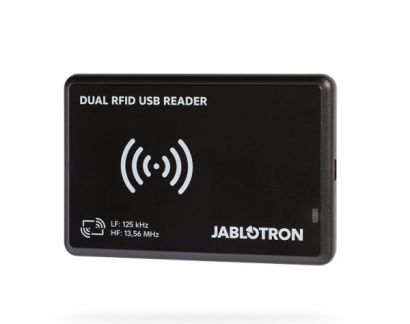
Jablotron JA-191T RFID card and key-tag Reader
The Jablotron JA-191T RFID card and key-tag reader designed to enroll cards and key-tags.
Dual RFID USB Reader.
Availability: In stock
SKU
JA-191T


Jablotron JA-191T Dual RFID USB Reader
The Jablotron JA-191T is a versatile dual-frequency RFID USB card and key-tag reader - ideal for managing access control via RFID cards or key-fobs in security, hotel, or corporate environments. It offers reliable performance, broad compatibility, and easy integration with computer-based management systems.
Key Features
- Dual-frequency support: 125 kHz (EM MARIN) and 13.56 MHz (MIFARE®) for broad RFID media compatibility
- USB-powered and connected - plug into any standard USB port for immediate use (5 V DC input)
- Wide compatibility: supports a variety of RFID cards and PITs for access control, hotel reception check-in, employee identification and system enrolment
- No special drivers required: recognized automatically by Windows 10 and Windows 11 as a composite USB device
- Visual and acoustic feedback on read (red/green LED + beep) confirming successful scan
Technical Specifications
- Power supply: USB 5 V DC
- Typical current consumption: ~68 mA; maximum power consumption: ≤ 0.59 W
- RFID reading range: ~5 cm (ISO card, both 125 kHz and 13.56 MHz)
- Supported media types: MIFARE®, EM MARIN and other compatible RFID cards / key-fobs / PITs
- Interface: USB (Mini-B) for connection to PC or laptop
- Operating systems supported: Microsoft Windows 10 and Windows 11 (no extra drivers needed)
Typical Applications
- Enrollment and management of RFID cards/key-fobs in building security systems (e.g. access control for offices, warehouses or secure zones)
- Hotel, guesthouse or reception-based issuing and administration of access cards or key-fobs for guests or staff
- Corporate employee badge programming and access management via RFID credentials
- Alarm system integration as part of a broader security/monitoring solution using the manufacturer’s RFID-based access infrastructure
Customer Reviews
Questions
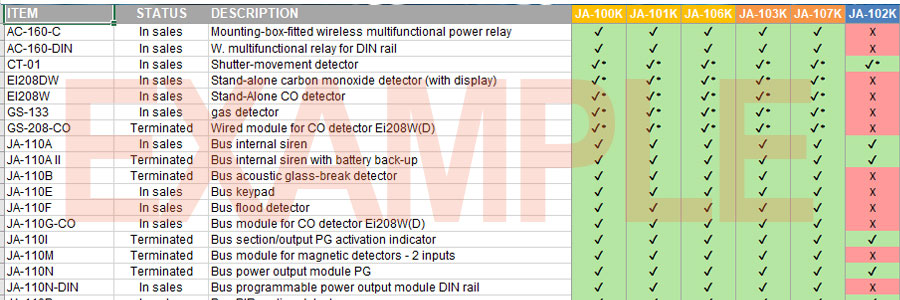
Hello, is there a compatibility overview of the Jablotron 100 components?
Question by: Frank on Sep 25, 2026, 2:42 PM
Answer by: Frank Ligthart (Admin) on Sep 25, 2026, 2:43 PM
Hello, can you please explain the differences in RFiD, EM and MiFare protocols.
Thanks
Thanks
Question by: Frank on Feb 24, 2026, 9:45 AM
MIFARE, RFID, Wiegand, and EM represent different components and technologies within the access control and identification industry. RFID is the overarching radio technology, MIFARE and EM are specific types of RFID, and Wiegand is the protocol used to communicate that data.
RFID - Radio Frequency Identification
RFID is the broad technology that uses radio waves to identify objects or people. It consists of a tag (card/fob) and a reader.
RFID allows contactless reading of data. It is divided into Low Frequency (LF), High Frequency (HF), and Ultra-High Frequency (UHF).
Key Difference: This is the umbrella term for all radio technologies.
EM Protocol (EM4100/EM4200) - 125kHz
EM cards are a popular type of 125 kHz Low-Frequency (LF) RFID tag, often called "Proximity" cards.
These cards transmit a fixed 40-bit or 64-bit ID number when placed near a reader. They are passive and do not have internal security, meaning they are very easy to clone.
Key Difference: Low cost, no data storage capacity, easily cloned, and low security. Best for basic entry.
MIFARE (NXP Semiconductors) - 13.56MHz
MIFARE is a brand of 13.56 MHz High-Frequency (HF) RFID smart cards, complying with ISO/IEC 14443A.
MIFARE cards are "smart cards" that have an embedded microcontroller and memory. They support mutual authentication (the reader authenticates the card, and vice versa).
Regards
RFID - Radio Frequency Identification
RFID is the broad technology that uses radio waves to identify objects or people. It consists of a tag (card/fob) and a reader.
RFID allows contactless reading of data. It is divided into Low Frequency (LF), High Frequency (HF), and Ultra-High Frequency (UHF).
Key Difference: This is the umbrella term for all radio technologies.
EM Protocol (EM4100/EM4200) - 125kHz
EM cards are a popular type of 125 kHz Low-Frequency (LF) RFID tag, often called "Proximity" cards.
These cards transmit a fixed 40-bit or 64-bit ID number when placed near a reader. They are passive and do not have internal security, meaning they are very easy to clone.
Key Difference: Low cost, no data storage capacity, easily cloned, and low security. Best for basic entry.
MIFARE (NXP Semiconductors) - 13.56MHz
MIFARE is a brand of 13.56 MHz High-Frequency (HF) RFID smart cards, complying with ISO/IEC 14443A.
MIFARE cards are "smart cards" that have an embedded microcontroller and memory. They support mutual authentication (the reader authenticates the card, and vice versa).
Regards
Answer by: Frank Ligthart (Admin) on Apr 24, 2026, 12:20 PM